🐟 🪝 🌡️
Identifying drivers of fish stocks using causality assessment framework
This project was based on my Master’s thesis work within ISEM. It was under the supervision of Vasilis Dakos and Alejandro Viloria Cano. The findings are still being prepared for publication.
Summary
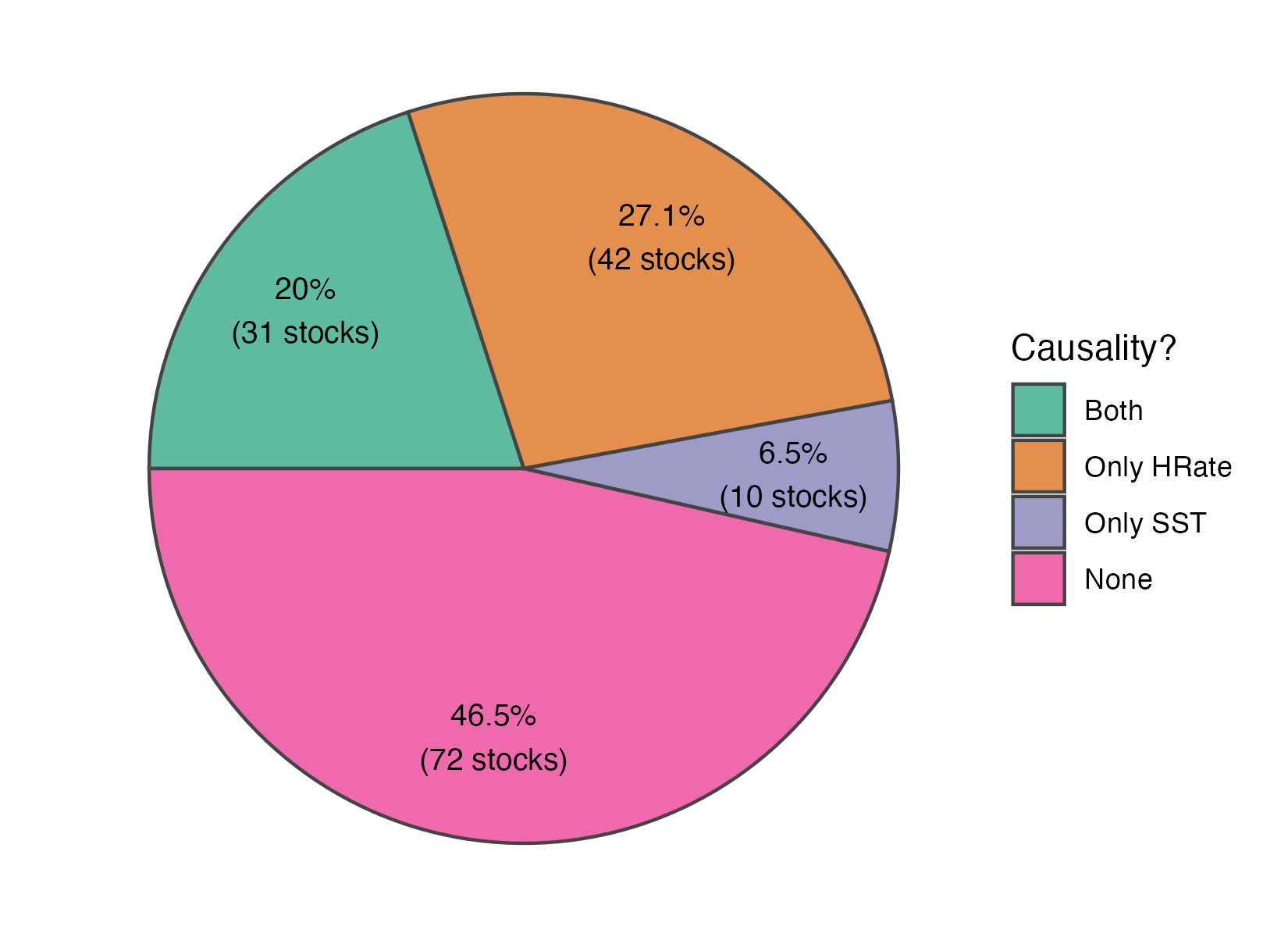
Global fisheries are under pressure from overfishing and climate change. While attribution methodologies provide outstanding information on the drivers of biodiversity change, they mostly rely on mechanistic models, species distribution models, controlled environment experiments, and expert knowledge. Here, a data-driven, equation-free method (Empirical Dynamic Modeling / Convergent Cross-Mapping) was applied to 150+ global fish stocks to directly test whether harvest rate and sea surface temperature (SST) cause changes in stock productivity.
Fishing pressure was the most common causal driver, confirming that exploitation strongly shapes stock dynamics. Its effect was stock-specific, but mostly positive, and also often becoming more negative over time, indicating that fishing impacts are worsening.
SST was also identified as a significant causal driver, showing that climate change impacts productivity. Unlike fishing, the effect of warming was mostly negative and often became even more negative over time, suggesting that climate impacts are intensifying.
Overall, this work shows that:
- Data-driven causality approaches can complement traditional models to identify drivers of fish stock dynamics.
- Fishing remains the dominant driver, but its effect depends on the stock, even if often getting more negative over time.
- Climate warming is a driver, mainly negative and intensifying over time.
Preprint
Master’s Thesis
Note that the report (Master Thesis) below is not a peer-reviewed work and may contain errors. Especially, the section related to the quantification of causal strength using S-map contains errors in methods: in paragraph 2.7 Confidence and Causal Strength, there is a confusion between cause and consequence variable.