publications
Collection of publications.
2026
- Sensitivity of Fish Stock Trajectories to Climate Forcing and Human Exploitation at a Global ScaleRaphaël Benerradi, Vasilis Dakos, and Alejandro V CanoJournal of The Royal Society Interface, Aug 2026
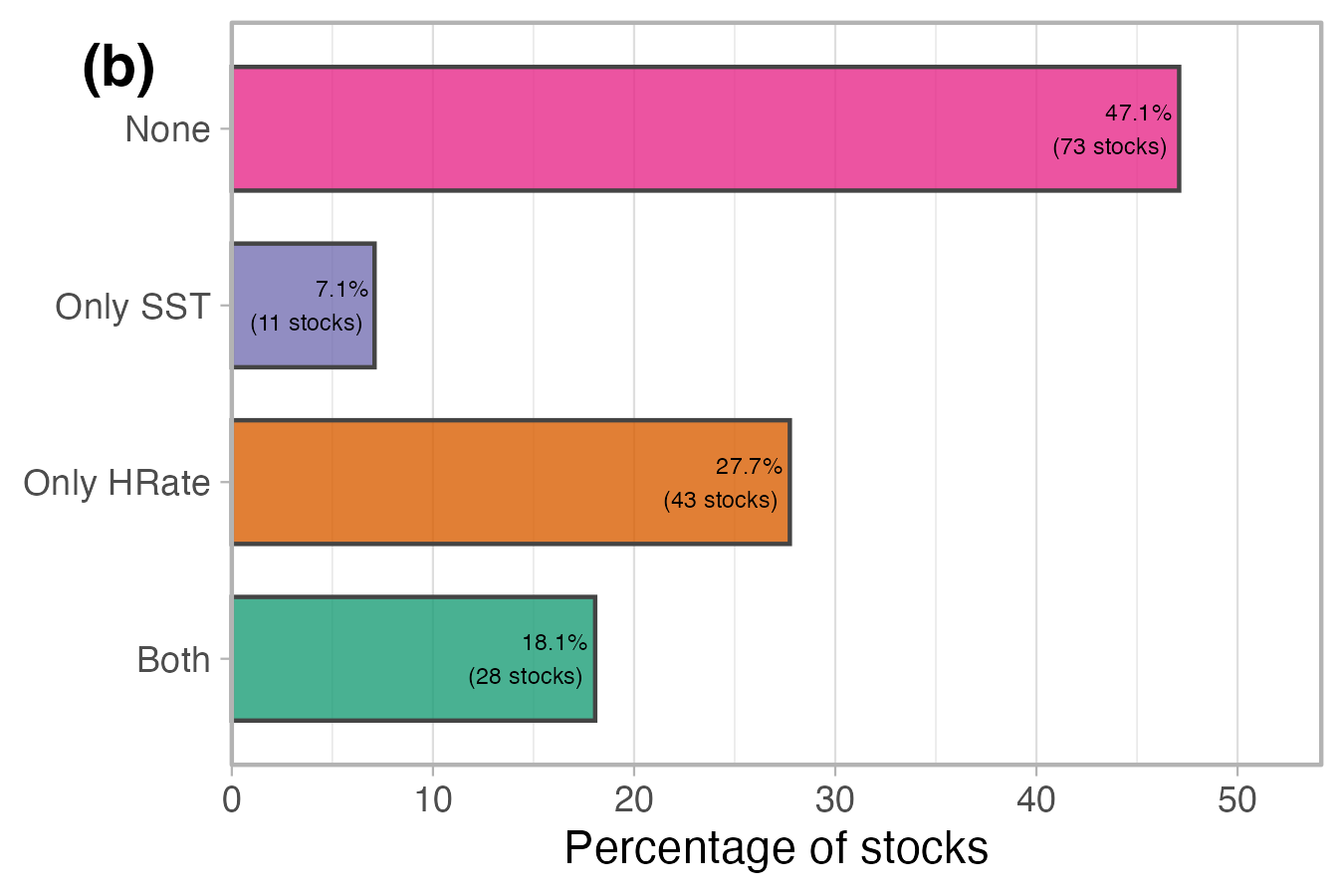
Global fisheries are under increasing pressure from overfishing and climate change, threatening marine biodiversity and food security. Disentangling the impacts of these two drivers is essential for sustainable management, yet it remains a major challenge due to the complex nature of marine ecosystems. Here, we utilize a data-driven empirical dynamic modelling framework to assess causal relationships between harvest rate, sea surface temperature (SST), and the productivity of 155 fish stocks worldwide. Our analysis identifies fishing pressure as the most prevalent driver of stock productivity, with a causal link detected in 71 stocks (45.8%). SST was also identified as a significant driver of productivity in 39 stocks (25.2%). While the impact of harvest rate was stock-specific, being either positive or negative, the influence of SST was predominantly negative and, in many cases, intensified over time. These results provide empirical evidence that direct exploitation and climate warming are systematically impacting fish stock productivity, with direct exploitation emerging as the predominant driver across stocks. This predominance suggests that improved harvest management could help buffer or mitigate some of the negative impacts of climate warming on fisheries productivity.
@article{benerradi2026sensitivity,
  title = {Sensitivity of Fish Stock Trajectories to Climate Forcing and Human Exploitation at a Global Scale},
  author = {Benerradi, Rapha{\"e}l and Dakos, Vasilis and Cano, Alejandro V},
  year = {2026},
  month = aug,
  journal = {Journal of The Royal Society Interface},
  volume = {23},
  number = {241},
  pages = {20251040},
  issn = {1742-5689},
  doi = {10.1098/rsif.2025.1040},
  urldate = {2026-08-15},
  url = {https://royalsocietypublishing.org/rsif/article/23/241/20251040/482743/Sensitivity-of-fish-stock-trajectories-to-climate},
}

2025
- Effects of Linear Openings in Forests on Temperate Bird CommunitiesMariela Yapu-Alcazar, Raphaël Benerradi, Michael Wohlwend, and 3 more authorsEcology and Evolution, Aug 2025
Narrow, unpaved forest roads and paths are a ubiquitous feature of managed forest landscapes worldwide, with the potential to influence bird communities. However, compared to large roads, the effects of structural changes to the understory and canopy generated by unpaved forest roads and paths are less understood. In this study, we investigate the influence of narrow linear openings in the forest caused by forest roads and paths on bird communities in the southern Black Forest, Germany. We surveyed bird communities in four distinct plot types, including two “linear openings”: forest interior, forest paths, forest roads, and forest edges. Forest roads and paths were expected to represent intermediate conditions in terms of openness between interior forests and a forest edge. We aim to understand how these linear openings affect birds’ species richness, community composition, and functional traits. Our results show that while species richness remains similar among plot types, the community composition at forest edges differs. The indicator analysis reveals indicator species for each type of plot. In addition, functional traits like body mass and wing shape showed a weak response to the linear openings. The findings suggest that although unpaved forest roads and paths potentially introduce resources and structural modifications in the forest structure, the effect on the birds seems limited compared to pronounced habitat transitions, such as forest edges. These narrow linear infrastructures are often necessary for forest use by humans and can be unnoticeable for birds when carefully planned on a small scale. Nevertheless, forest managers should not overlook broader-scale effects (e.g., potential habitat loss, predation). Our findings contribute to a better understanding of birds’ responses to linear and small-scale fragmentation introduced by unpaved forest roads and paths. However, more research is needed to distinguish the ecological impacts and management implications for bird communities in temperate managed forests along a gradient of linear openness.
@article{yapu2025effects,
  title = {Effects of Linear Openings in Forests on Temperate Bird Communities},
  author = {Yapu-Alcazar, Mariela and Benerradi, Raphaël and Wohlwend, Michael and Mikusiński, Grzegorz and Storch, Ilse and Bhardwaj, Manisha},
  journal = {Ecology and Evolution},
  volume = {15},
  number = {11},
  pages = {e72466},
  year = {2025},
  doi = {10.1002/ece3.72466},
  url = {https://onlinelibrary.wiley.com/doi/abs/10.1002/ece3.72466},
  eprint = {https://onlinelibrary.wiley.com/doi/pdf/10.1002/ece3.72466},
}
