🌿 🌍 📉
PhD project - Estimating spatio-temporal trends of plant species using Opportunistic Citizen science data
This project is my PhD thesis work at Université de Montpellier (France), in Inria/LIRMM team. It started in October 2024 under the supervision of Alexis Joly, Maximilien Servajean, and Christophe Botella.
The current directions are described below.
I'm open to suggestions and collaborations, feel free to contact me!
Summary
Monitoring species distributions is critical for understanding ecological dynamics and informing conservation efforts, especially in the context of current global changes. Although opportunistic data from citizen science programs offer extensive spatial and temporal coverage, they are affected by substantial sampling and detection biases. This PhD thesis proposes a method for estimating species distributions and their temporal trends from presence-only data using hierarchical site-occupancy models that account for both types of bias. We explore the use of deep learning to fit these models efficiently and flexibly. We plan to apply this framework to real-world datasets, such as Pl@ntNet, and further investigate model extensions that incorporate more complex observer behaviors and detection processes using various neural network architectures. We will use these models to assess trends in plant species in terms of coverage, population changes and range shifts. Furthermore, one of the objectives of this PhD is to study the factors that influence these trends such as land use changes, climate change, and pollution.
Part 1: Deep Occupancy Models for Presence-Only Data
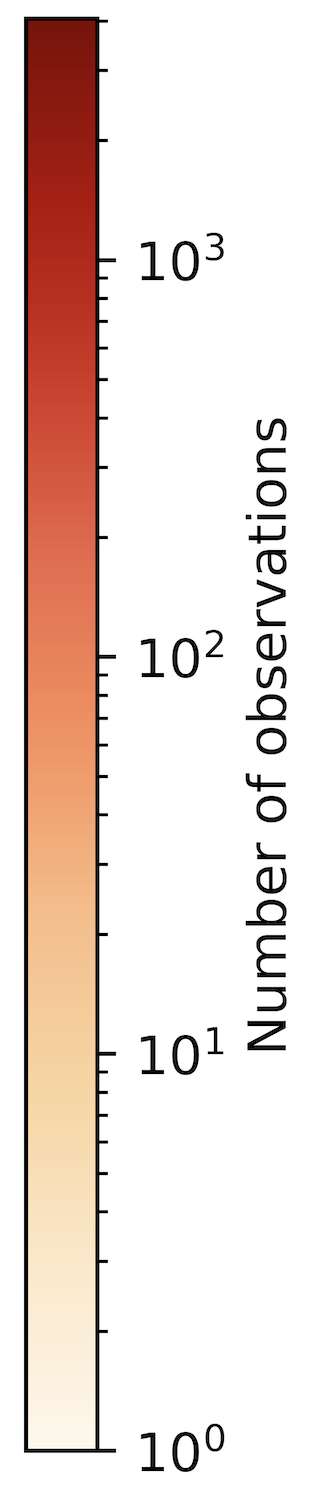
Opportunistic citizen science datasets are prone to various biases, including sampling bias (spatio-temporal variations in sampling effort) and detection bias (variations in detectability or reporting across species). These phenomena are also evident in the Pl@ntNet dataset, with an increasing number of observations over the years and a higher number of records during spring.
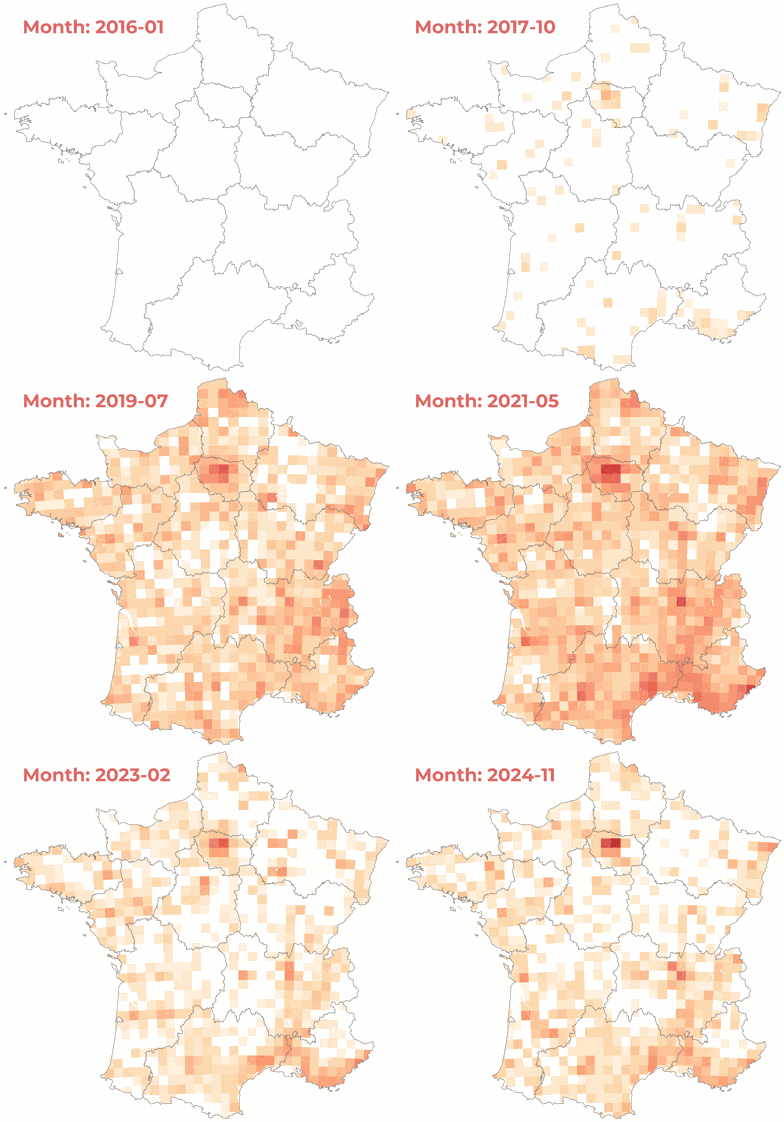
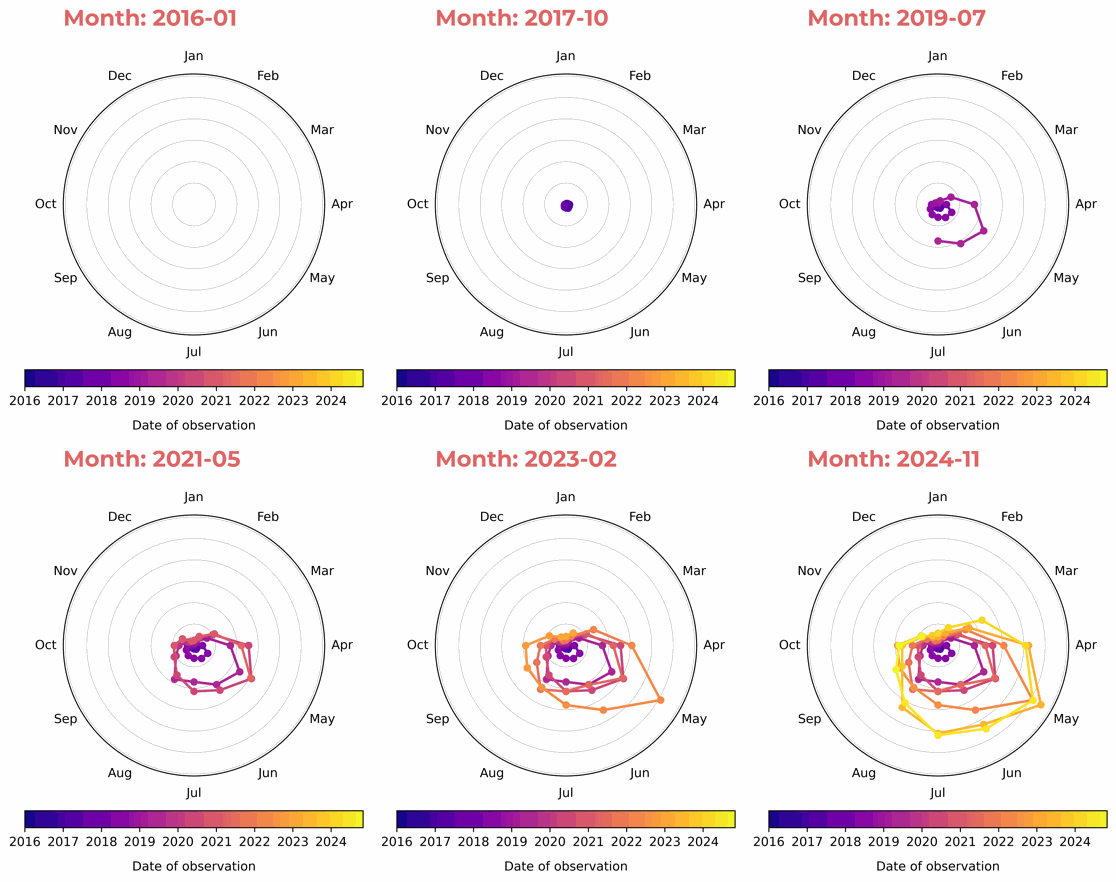
To address these issues and estimate species distributions using large-scale opportunistic presence-only data, we propose to use hierarchical occupancy models that explicitly account for imperfect detection while also correcting for sampling biases.
Occupancy models are identifiable when the number of sites and visits is sufficiently large. However, this identifiability becomes less clear with finite datasets, especially when detection probabilities are low. We are currently studying the accuracy of the estimation of occupancy and detection probabilities using occupancy models on large scale citizen science datasets.
To do so, we developed a Python package called OccuPYcy for occupancy modeling and analysis, aimed at being:
- Flexible: Use linear, non-linear, or neural architectures (PyTorch-based) for occupancy and detection.
- Scalable: Designed for large-scale and complex citizen science datasets: Efficient memory use, stochastic optimization, and support for millions of observations with uneven effort.
- Customizable: Easily plug in your own covariates, model architectures, and penalty functions.
- Open Science: Documentation, examples, and installation instructions are available on GitHub.
More details in the project page or in the GitHub repository below:
The package is nearly cooked and will be released soon! 🧑🍳 Expected launch: end of June 2026.